Sunday, August 29, 2010

My Life..

Hi folks. I just wanted to update you on what is up with my life and why I haven't been blogging (or reading my email)!

About 6 weeks ago, I accepted an exciting almost FT job. Now, I'm working this in addition to helping with our family's small business. Consequently, we've enrolled our son into private school (a huge transition from homeschooling).

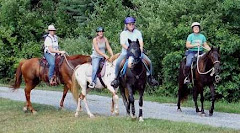
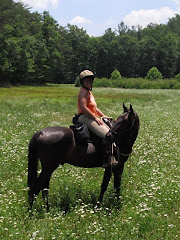
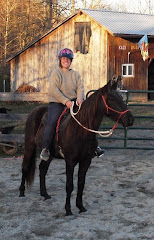
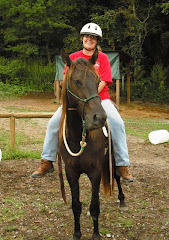
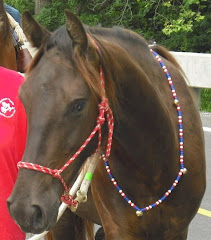
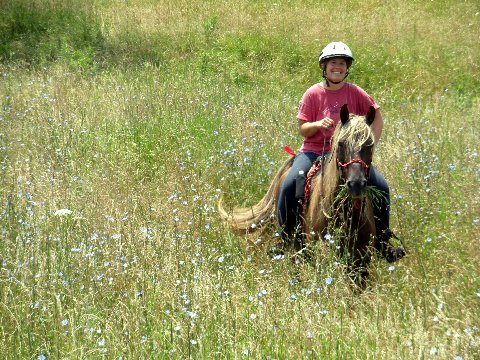
Wow. Lots of life changes!! Today, I got to sit on Guinness for the first time in 2 1/2 weeks. (We went for a fun little trail ride with some friends.)

I have lots to blog about and hopefully will have some time soon. :-)

Sunday, August 8, 2010

Learning Together

This afternoon, I found a little time to play with Guinness. It started off with my husband climbing onto the roof of the run-in to clean out the gutter. Guinness stood in absolute amazement as my husband scaled the ladder and began to walk on the tin roof (with associated bangs and thumps). Guinness took turns standing just behind be and staring, or nonchalantly hanging out inside the run-in as I groomed & scratched him. It was *very* interesting to observe his reactions. I wish that I'd had a camera..

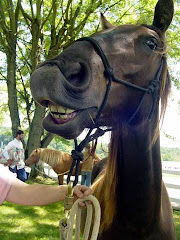
This morphed into a liberty clicker training session in the paddock where we mostly played with posing, and turns on the forehand. "Posing" is when Guinness parks-out and holds his neck arched, head lowered, and lips away from me! He is totally getting the hang of this and is very proud of himself.

For "turns on the forehand" I decided to try break the task down into parts that I could more easily convey to him. He has the idea to yield his HQ down pat, but doesn't get that he needs to keep his inside front foot still. I found a piece of rubber mat and asked him to put his foot on it. Then I asked for his HQ to move over one step while keeping his foot on the mat (I stood in zone 3 with my stick in my inside hand pointed toward his nose, while my outside hand reached around to press gently on his side and I looked at his HQ. It worked really well! We played with me on his left side today. For the Fair next weekend, he is supposed to be able to keep one foot in a hula-hoop for this task. I don't know if I can get him ready in time for that or not..

After a while, I was getting tired of playing in the paddock, but he was still happy to be with me, so I tacked him up with his bareback pad and halter/lead rope. I brought him out of the paddock and into the front yard, where I pulled up a plastic chair to mount and then allowed him to graze. (Smokey called and called to him, but thankfully Guinness didn't seem to pay him much attention.)

Eventually, I directed him to a recently mowed path through the woods. I practiced asking him to walk by lifting my reins, bringing up my life, moving my rear to suggest a walk, and then clicking him when he was on the right track. I was careful not to escalate my cues and not to use my lower leg except to steer him. Once he'd willingly walked several paces, I would halt him with my seat and then cue him to eat (by pressing on his main near his withers). We also played with trotting and cantering in the same manner.

I love the idea of using grass as the "green carpet of motivation" and it really works! Plus, by putting his grazing under saddle on a cue, it seems to have reduced his determination to argue with me about it and instead to seek to gain it as a reward. I used almost no rein during this ride except for a few times to rate his speed by lifting one rein or to reinforce a halt cue (again using one rein). This was really the first time that I have consciously used CT to reinforce gait and speed cues. For this (and other tasks) I click with my tongue periodically to signal that he is doing the correct thing (when he seems to be hesitant), and then I multi-click when he has earned a treat. It is working great - no resistance from him at all.

One of the most important things to me about today's session was that I played approach and retreat with my OWN anxiety about riding at home! I know that this sounds silly, but I'm way more comfortable and have had much more practice riding Guinness elsewhere. At home, things tend to get in the way of my riding, plus I have baggage associated with Smokey getting herdbound and going RBE (my least favorite state of horse brain). (See previous post "Backyard Bravery" - I haven't ridden at home since I posted it on May 31st..) Guinness was actually more comfortable with this than I was and we had a great time looping around out in the woods for about a half hour.

Afterward, I slid off over his rump and sat on the ground as he grazed on tender grass behind the barn. Eventually, I lay down and dozed and looked at the clouds & trees as he munched and stood guard several feet away. At the time it occurred to me that this was a very herdmate-like thing to do together. I often see one horse laying down on the field while a buddy acts as a lookout. I even crawled UNDER him for the first time. :-)

When I returned him to his pasture, I went with him to the dusty spot and suggested that he roll, which I did with him. What a fun afternoon!

****************

PS - I'm reading a new book: Reaching the Animal Mind by Karen Pryor (author of "Don't Shoot the Dog" - recently recommended reading by Pat Parelli). I'm sure that I will be posting more about it soon. So far, it is totally fascinating.

PPS - Guinness won 2nd in that little trail class competition last week and we took home a basket of *wonderful* homegrown tomatoes for our efforts.

PPPS - Just watched this clip and loved it. Especially that last part with the bowing and laying down!

Monday, August 2, 2010

Turns on the Forehand

This evening, just before dark, I decided to play with Guinness with emphasis on practicing turns on the forehand. In preparation, I chopped up some carrots and bagged up his dinner, then went to the roundpen to wait for him.

After a few minutes, as I was dozing, he briskly walked over to the roundpen and stared at me. I invited him in and he offered circling game. I encouraged him to walk around me and he did 3 laps in both directions, no problem.

Next, I asked him to do a little sideways over an object. He has the sideways down, but doesn't get the "over an object" part yet. He tends to trample all over it. We need to practice more with barrels..

Then we approached a large pink hula-hoop with the intention of eventually having him turn on the forehand with one foot planted within the hoola-hoop. Fortunately, the rattly noise didn't bother him a bit. We practiced with me in zone 3, lifting the rope with my inside hand, turning and looking at his HQ, and porcupining him a little with my outside hand. He would swing around well, but a bit too quickly. Next time, I'm going to have him take one step and then stop (repeat).

We played with the same task mounted and I got him to pretty much plant his inside front foot, however he was still too quick to be precise.

When I asked him to back up, he offered me a lovely parade-style rear, which cracked me up. However, I didn't dare click it or he'd be offering it to be every time! I think that I must have cued him too strongly considering that I was sitting directly on him bareback without a pad..

After walking forward a bit, I dismounted and asked him to sidepass over some cones (laying down). Eventually, he did it pretty well and he won his grain.

In hindsight, I think that the carrot pennies that I took out for treats today were too yummy for him to concentrate well. I need to go back to cheerios.

Tomorrow evening is the final trail obstacle class and I believe that there will be a little competition. We'll see how it goes!

Saturday, July 31, 2010

Chiropractic & Accupuncture

Last Monday, fellow PPG member and veterinarian, Anna Simms, came out to give Guinness a tune-up.

This was my first experience with equine chiropractic or acupuncture.

It was a very interesting and informative session. Guinness enjoyed the attention, although a couple of times he swatted the needles as though they were biting flies.

Anna noticed that G. has a slight drop of the left hip while walking and somewhat more muscle development on the left side of his lumbar region. He also exhibited a slight restriction in the motion of his caudal ribs on the right side.

She recommended several stretches, but overall believed most issues to be developmental in nature.

After the basic exam, I asked her to check out the "stick" that I'd been feeling in Guinness' ear. I could feel it by poking my pinky finger way down into his left ear (the length of my finger)! We tried to look into his ear with her otoscope, but couldn't get a good look. We put some rubbing alcohol into both of his ears to encourage him to shake his head. It worked and brought the object a little closer to the opening of his ear.

Barring other alternatives, she stuck her little finger with long fingernail into his ear and dragged a little stuff out. We examined the crud and then noticed a hunk of something hanging from his ear! It appeared to be an inch-long piece of straw. It had been in his ear so long that it was partially decayed at one end and covered in waxy stuff. Yucky.

Anyway, during this whole thing Guinness was a champ. He even held his head down while we took turns doing weird things to his ear. While we were at it Anna commented, "I can't believe that he is allowing us to do all of this to him!" I think that he knew we were trying to help him out. ;-)

Wednesday, July 28, 2010

"Secrets" for Winning the Games! (Especially with LBIs)

The "secrets" to winning all of the Games - every one of them - have been hiding in plain sight. Who would have thought? I had a huge BFO insight this evening while playing with Guinness and I want to share it with you guys!!

Prerequisites to Play

Your horse must feel safe and comfortable. He must know that you will not hurt him intentionally and that you are looking out for him (smashing horse flies and scratching where he asks are good tactics). Try at all costs to avoid doing things "to" the horse, but instead ask him to help you out. This includes hoof picking, grooming, trailer loading, vet care, you name it. Make it a principle in your life with your horse. Clicker training helps a ton with this because it provides a clear structure for communication plus incentive for the horse.

Step 1: Find the "game" in the Game

Think of what you are wanting the horse to learn to do - not just DO but LEARN TO DO. Then think of how you could turn it into a game that a toddler or 8 year old kid would want to play. Think of a few simple rules and a clear goal/reward. Really break it down into something that you can convey to your horse. If you can't do that, whatever you do, don't try to play it with your horse until you can!! Remember, you want this to be a Win-Win game.

Step 2: Make 'em beg to play

Put some treats in your pouch (and perhaps even his dinner as a jackpot) and mosey out to the play area. I even put out an empty feed pan to emphasize that I might be worth seeking out. Then deliberately ignore your horse until he comes to check you out. It is ok for him to gently sniff and explore your treat pouch. Just NO biting, pinned ears or rudeness of any kind. If you've been clicker training already, he will know that mugging you isn't the way to win treats. Use your stick if needed to protect your space until he sweetly approaches and asks to play. Yup, make him ask. Those little nudges to your pouch would be an "ask". So could staring at you intently with ears forward, showing you his feed pan, offering behaviors, etc.

Step 3: Allow them to feel successful

Start by playing a few simple things that they already know. For instance, Guinness loves to fetch objects, to smile, and to park out. When I ask him for these behaviors, he is confident about responding and earning his reward (which might be just a good brief scratch, at this point).

Step 4: Release all pressure

After a few little successes, take all pressure off of him by sitting down, turn slightly away, looking hazily off into the distance, "grazing", rolling, or whatever. Let him take some deep breaths and lower his head, if he so desires.

Step 5: Be happy to resume play when he asks you to

When he gives you a sign that he wants you to do more (see Step 2), bring up your life (stand tall & make eye contact) and then ask clearly for him to do something, keeping in mind the game that you'd like it to morph into. Be precise. Have a small but clear goal in mind. If he doesn't comply, completely disregard it (see Step 4) and wait until he asks you to play some more! DON'T NAG. Trust me, he will soon figure out that he wants to keep YOU engaged with him. ;-) When he achieves the goal, click/treat, and wait for him to ask for more play. If he tries, but gets tangled up, very clearly redirect him in SLOW motion, then TAG firmly where was - intentionally missing him. When he tries, allow him to win but maybe a much lesser reward than if he really figured it out (say, perhaps a stroke on the nose instead of a treat).

Step 6: Be progressive

Gradually add longer duration or more precision. In exchange, give better rewards. As I get closer to my ultimate goal for the session, I start to dole out bits of grain or apples, instead of just alfalfa cubes or cheerios. Between each burst of activity, wait until he gives you the sign that he is ready for more.

Step 7: Jackpot

When he reaches the goal for the session, click (perhaps lots of times for emphasis) and dump the jackpot of grain or something else blissful into his pan. Leave him alone to enjoy it. Then say goodbye and turn him out with his buddies. He will tell them that he just had the best "date" ever. Repeat this whole sequence a few sessions in a row, and I'd bet that he will be galloping across the field to try to get you to come play!

*********************************

This is how Guinness and I played the Circling Game this evening, progressing up to 6 laps without correction in each direction at liberty. I was totally neutral with my hands behind my back, except I did stand tall and kept some energy in my body while I wanted him to continue to move. I really exaggerated tilting my head at his rear when I wanted him to disengage and come in. If he came in before I asked, I stroke his nose once, then backed him out and resent him in the same direction. I asked for him to work up to 6 laps in one direction, before switching to the other, to reinforce that I wanted him to continue in the direction that I'd asked for. Whenever he'd stop, I'd say out loud "where is the horse?" in a voice just like I'd use to play peek-a-boo, smile, and turn in slow motion in the direction of travel until I spotted his rump. Then I'd slow motion tag that spot firmly. He'd be sure to leap out of the way just in time. After a few repetitions, as soon as I'd say "where is the horse?" and think about turning and he'd resume moving in the correct direction.

Now that I feel that he totally understands the game of "keep going in the direction that I sent you until I call you in," I'm going to progress into rewarding only a particular gait. This evening, he was so into it that he was offering to canter so that he could get his laps done faster, without any increase in pressure from me. Next time, we will go from walking to cantering because he is still having difficulty finding and maintaining a consistent trot (due to his ability to both trot & pace). Cantering seems to be his favorite gait.

Now I understand Linda Parelli's comment about needing to use treats as incentive until she got more savvy about the psychology of PLAYING with her horses. I could see now how the treats will soon become secondary to stimulating his play drive, at least once beyond the learning phase for each behavior.

Super wow.

PS - In my experience, these games are best learned at liberty, if at all possible. Some horses feel pressure and react differently merely with a lead line attached to their halter.. When you take off the halter, "all that's left is the truth!"

Sunday, July 25, 2010

You've Come a Long Way, Baby!

Last weekend, the SWVA Natural Horsemanship Club hosted its annual Trail Competition. This was the second time that Guinness and I have participated in it together.
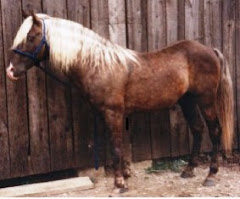
Last year, I was thrilled that we took 4th place out of 6 or so competitors in the "unmounted" division. (At age 2, he was the youngest horse there and the only one not yet under saddle.)

This year, I'm excited to announce that he won 2nd in the "mounted" division against 9 other teams! My L3/4 PNH friend, Alyssa, & her partner of 8 years, Delilah, won first place.

I have to thank Alyssa for her insights into both sideways game & directional backing (discussed in previous posts). They made it possible for Guinness & I to do as well as we did.

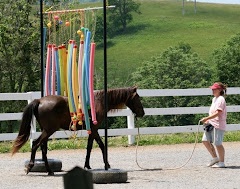
Here is this year's list of obstacles:
1. ground tie
2. walk in-hand then trot in-hand
3. join up & walk (no lead)
4. mount and be measured
5. sprinkler
6. rope gate
7. creek crossing #1
8. deadfall
9. 360 turn on tarp in box
10. back into stanchion
11. jump hay bales
12. weave cones
13. ground poles
14. bag drag
15. 3 gaits around roundbale
16. mailbox
17. back thru L (gate panels)
18. back thru 2 barrels, around 3rd barrel, back thru 2 barrels
19. large flag carry
20. creek crossing #2
21. back up steep incline
22. send onto trailer

Our two lowest scores were for turning a 360 & jumping the hay bales.

We had a very fun weekend and even stayed over the night before the competition, after helping to set up obstacles. Guinness met another Rocky, Lakota (age 5), and they became fast friends in the field - but surprisingly, didn't call to each other when with their humans.

We even cantered around quite a bit from place to place. Now that I know that Guinness isn't inclined to run off with me, I'm able to relax and enjoy it.

I can't wait until the trail classes at the Fair!


PS - Guinness had no right-brained moments, it was LB all the way.


The Optimistic Horse

I started writing this post several days ago, as I started reading the book, "The Optimistic Child" by Martin Seligman, and was overwhelmed by what I read and how it fits into what I'm living & learning right now!

Here are a few excepts from the book (paraphrased by me):

In 1964, Seligman decided to study experimental psych in a lab run by Richard Soloman. The grad students there were trying to find out how fear energized adaptive behavior. To do this, they would pair an electric shock with a signal [neurons that fire together, wire together] and then put them in a chamber in which running to the other side would turn off the shock. To the dismay of the grad students, the dogs just sat passively without moving. This phenomenon has come to be known as "learned helplessness" - the pattern of giving up without trying.

Learned helplessness requires learning the concept that "nothing I do matters" and is evidence that animals can think in abstractions. Learned helplessness looks very much like depression in both animals and humans. It can be cured by teaching animals (people too!) that their actions have direct effects, and can be prevented by providing experience with mastery and success.

The trick is to teach an animal that they could control a situation by taking action, before they have experience with inescapable shock. These "immunized" (against learned helplessness) animals never gave into helplessness, and when they later got inescapable shock, they did NOT become passive.

Masterful action is the crucible in which optimism is forged. The opposite message is "When things don't go as you want, give up and let someone else rescue you." Rather, strive to encourage perseverance and active problem solving.

Marker/reward based training (such as Clicker Training) is especially useful for empowering many types of animals - from chickens to horses to whales!

Two other awesome books that I've recently read that also expound upon these ideas:

The Brain that Changes Itself

Animals Make Us Human

I'm certainly not done with this exploration, but I wanted to go on and post this.

I'm feeling the happiest that I have in years and I'm certain that it is due to the sudden progress in both my horse & work life. Although my house is still a pit, I'm no longer feeling stuck. : -)